The 'Couv'

The 'Couv'

Tuesday, October 24, 2023

Some Bankers think Relief is Coming Next Year

originally posted in Rod's Real Estate News, 9/29/2023

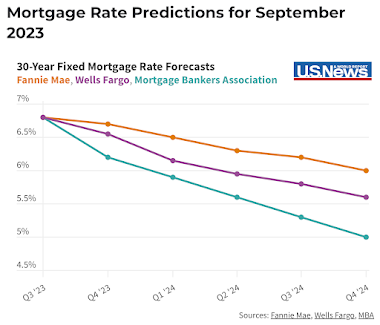
According to US News and World Report the trend for the next few months is a softening in rate pressure. Rates should start to ease a bit providing some relief for weary buyers that have been priced out of mortgages over the last couple years. Locally rates have been running at nearly 8% well above the national average. The chart below shows the national trend and the rates on the chart or prior to any fees or points that banks are in fact charging. Rates that borrowers are actually seeing or will see based on this chart would be 0.5% to 1% higher. Rates also vary based on the lending program, down payment amount, credit profile and other important financial details of the borrower. The good news is they seem to think it is starting to trend favorably for borrowers.

Well let's hope they are right. I do not expect a return to the ridiculously low rates of a few years ago. That was unprecedented. The 50 year average has been around 6.5% and I find that the market responds well to rates under 6%. If we can get rates back into the mid 6s the real estate market will come around. Right now we are in a stalemate as we have neither allot of buyers nor allot of sellers. Pricing is stable but softening and transactions are way down as a result of inactivity. Sellers are holding on to the low rate they have now and buyers can't afford the high rates currently available. 

This trend if it materializes could be good for current buyers. Sellers are getting motivated and that means a negotiating edge for buyers. Buyers may find themselves able to refinance their 8% purchase not in a year or so at a more comfortable rate in the 6s.  

If that chart holds up, things should perk up a bit next spring.

Wednesday, September 27, 2023

Vancouver's Urban Core Still Booming

Vancouver has seen a tremendous growth boom in the city center over the last seven or eight years. The skyline has been filled with an assortment of tower cranes hovering over large mid-rise and high-rise projects for better part of a decade now.

Retirees looking for that city living opportunity can enjoy a walkable neighborhood experience in Downtown Vancouver while living in one of dozens of secure mid-rise and high-rise apartment or condominium developments. The Springs Living is the latest senior living development and it is the largest such project in the area. The 12 story tower is topped out and expected to open sometime next summer on Vancouver's Waterfront.

Below is a video showing off some of the development and condo opportunities in Vancouver's urban core.  Take a look at the amazing progress in our city center.

Tuesday, August 22, 2023

Inflation Making Fixed Income a Challenge

Although the rate of inflation seems to have peaked it still remains a bit high at around 3.2%. Inflation tends to eat away at fixed income spending power especially since many COLA (Cost Of Living Adjustments) are capped at 2-3%. For retirees not having an income tax in Washington State helps quite a bit, but rising gas prices due largely to a sneaky tax the state applied recently cuts into the budget quite a bit. That gas tax will likely appear on the ballot in November for voter approval. If it is rejected gas prices will drop by nearly 50 cents a gallon.

It is important for voters, particularly retired people, to pay close attention to what our state and local politicians are doing. They are often sly like the fox and when they are it usually will hit us in the wallet. Locally the economy remains fairly strong all things considered and there is a great deal of positive activity happening. For retired people that means opportunity for part time work for extra cash. Employers have been struggling to fill positions for the last few years and many seniors are making some side hustle cash to help alleviate the pains of inflation.

In other news: The Springs Living on Block 18 at the Waterfront is topped out and they seem to be on track for a summer 2024 opening. This will be the premier retirement faculty in the region with 12 floors, a private restaurant and views galore. They will offer indecent living all the way to advance memory care. This is an exciting addition to Vancouver's already spectacular Waterfront. Urban Living in the Couv follows the project, here.

Tuesday, July 25, 2023

What Hits Your Wallet Harder, Income Tax or Sales Tax?

Well that's a loaded question up there in the headline. Honestly the best answer for an individual is found by consulting your tax professional. Everybody has a slightly different tax profile depending on a variety of variables in our excessively complex tax-code. Since most of us are stuck paying Federal Income Tax, the question really falls into the realm of state taxes. Locally in Washington State we do not levy an income tax on our residents. We do levy a rather stout at times sales tax on a broad range of taxable products. Our southern neighbor, Oregon does not have a sales tax but they do have a blistering income tax that pounds away at even the poorest of Oregon residents. 

The general rule of thumb is that an income tax is heavily burdensome on high income earners and a sales tax punishes the poor. The reason this is often cited is that poor people tend to avoid income tax as most income taxes have a base deduction that keeps the poor from paying a lot of tax. Someone earning $25,000 a year might only pay a couple hundred dollars in tax because their adjusted gross income could be as low as $5000 if they have a family and other tax subsidies. 

Sales tax seems burdensome to the poor as they have to pay it on all their purchases for which they struggle to earn enough money. Of course some of life's essentials are exempt from sales tax in particular, food products. But it is true that the poor feel the hit of a sales tax more than they do an income tax as again most truly poor residents will end up paying very little in income tax, even in Oregon where they start charging 8.75% at the adjusted gross income of just $9450 a YEAR! Ouch that's brutal.

So in general a retiree with a strong pension or a large 401k distribution will definitely fare better in Washington State than neighboring Oregon. Many SW Washington residents shop in Oregon to avoid sales tax and in so doing are double dipping the system a bit. Bear in mind Washington's sales tax is also a use tax and technically Washingtonians are expected to report purchases out of state and pay the appropriate tax minus any local taxes. This is difficult for the state to enforce however other than items that require registration such as vehicles or firearms. Items shipped into the state from Oregon will also be subject tot he sale tax so yeas, you have to get in the car and drive ;)

If you are retired or soon to be so and are considering the Pacific Northwest, be sure to consult your tax professional for advice on whether the Sales Tax or the Income Tax is the bigger bite out of your wallet. 


Tuesday, June 27, 2023

Healthcare in SW Washington State

Healthcare is a critical piece for most retirees. As we age we find ourselves at the doctors office a bit more often. Access to that care is not equal in all places. Smaller cities and rural areas often have more limited resources and routine care for older people may require long trips to the "city." 

Southwest Washington has an abundance of healthcare options. Clark County in particular is rich with facilities and trips out of Clark County are rarely needed with a notable exception being Kaiser Permanente that has a few services only available Portland or at their Sunnyside (Clackamas) location. Vancouver has two large hospitals each with substantial cottage industry healthcare around them. 

Peace Health Southwest Washington Medical Center on Mill Plain in the Heights is one of the regions largest and most comprehensive hospitals. Legacy Salmon Creek is the second largest hospital in Clark County and also has a wide range of services available with numerous doctors offices and clinics nearby.

Kaiser Permanente operates several clinics ranging from small to large in Clark County mostly in Vancouver. Vancouver Clinic has numerous facilities in Vancouver and around Clark County with a broad range of outpatient services. The VA operates a clinic and small hospital near Fort Vancouver for our veterans. 

Local healthcare systems with a large presence in Clark County:

  • Peace Health, based in Vancouver, WA. Closest hospital, SW Washington Medical Center, Vancouver. Local clinics 10+
  • Legacy Health Care, based in Portland, OR. Closest hospital, Legacy Salmon Creek Hospital, Vancouver. Local clinics 10+
  • Kaiser Permanente, based in Oakland, CA. Nearest hospital, Interstate Medical Center, Portland (Kaiser contracts with Legacy Salmon Creek for some care). Local clinics 6+
  • Providence Health Care, based in Renton, WA. Nearest hospital, Providence Portland Medical Center, Portland, OR. Local clinics, 6+
  • Vancouver Clinic, based in Vancouver, WA. Closest hospital N/A. Local clinics 10+
  • Veterans Administration, based in Washington DC. Nearest hospital, Vancouver VA (limited services) Portland VA, Portland OR. Local clinics 3+
Washington States lack of income tax combined with a local robust healthcare network adds tremendous value for retirees in SW Washington especially the Vancouver area.

Tuesday, May 23, 2023

Inslee Signs Legislation ending SFR zoning, Good for Retirees?

Washington is not the first state to effectively end the Single Family Residence (SFR) zoning but they are the latest. As a real estate professional I have mixed feelings about this legislation. Although it is designed to help increase available housing and decrease suburban sprawl, it could have negative consequences for the very people it claim to help. Only time will tell of course.

The idea is that SFR neighborhoods consume allot of space and tends to be more expensive housing that excludes allot lower income people from affording. Allowing multifamily projects in these neighborhoods helps to increase housing that is traditionally more affordable. 

So what does the law really do? Well it states that cities with 25,000 to 75,000 people can not zone SFR and must allow at least duplex style (2 units) MFR (Multi Family Residential). In cities with more than 75,000 people which in Clark County means Vancouver only, four flexes are the minimum threshold. So in effect neighbors living in SFR neighborhoods could apply to convert their single family home into a duplex or four-plex depending on the size of their city. Having a bunch of four-flex units would definitely change the character of a neighborhood; generally for the worse. Quiet neighborhoods could become crowded, and obviously filled with renters that often do not take pride in the upkeep and presentation of the home. The upside is that more affordable housing becomes available and that could take pressure off rental prices.

There is another downside that I am 99% certain our legislators and governor are not smart enough to see. Politicians are usually not the brightest bulbs on the tree. That is that the dream of living in a quiet single family home neighborhood will likely evaporate for the people at the lower end of the middle class. A piece of the American Dream will be taken away from the very people the law is designed to help. Why is that, you ask? Because neighborhoods lacking duplexes and four flexes will slowly become more rare and thus more expensive pushing pricing even higher. Neighborhoods with a mix of SFR and MFR will become more affordable, but the true single family home experience will be missing.

So what does this have to do with retirees? Ah that is the question and the answer could be rather favorable. If this law survives the inevitable legal challenges, retirees living in a large house will legally have an option previously unavailable. Rather than sell the house and downsize, they could convert the house to multi-family and stay put utilizing one of the units as their own and renting the other(s) out to subsidize their income at a time when extra income is most appreciated. 

This will not be the solution for everyone and I am not sure whether this legislation will supercede deed restrictions (CCRs). It is worth watching for retirees that would like to stay in their current home but either cannot justify the expense of a large home or is unwilling to keep the larger space clean and tidy. This could provide income from an asset that very well may be paid off already. Not a bad way to go. 

As I understand the law, and let's be really clear here: I am a Realtor® not a lawyer, The laws does NOT prevent developers from building single family homes, it simply strips local government of the right to zone exclusively for single family homes. 

Locally, Vancouver is the only city in Clark County and in fact all of Southwest Washington that will be subject to the four-flex requirement. Battle Ground and Camas are large enough to fall into the duplex category as is Longview in Cowlitz County. Everywhere else in Clark County and Southwest Washington will be exempt from the restrictions this law places on zoning. So people living in Vancouver's unincorporated areas, which is nearly half of Vancouver's residents, should also be exempt from this law. Again I am not a lawyer so if you have genuine concerns consult an attorney or your local governing agency for clarification.  

The bottom line is that CCRs authority against the authority of this legislation will be a critical factor in determining whether this law will have more negatives than positive or more positives than negatives. If deed restrictions prevail then the law should be mostly favorable. Property rights are a big part of out constitutional rights and I take them very seriously. If you own property you should too.

Tuesday, April 25, 2023

Boomtown or Depressionville?

Originally published October, 23, 2018 by Rod Sager

Should Retirees Avoid areas with Strong Economies?

That seems like an odd question, right? Frankly, it is odd, yet there is merit to thinking it through. A strong economy is very important for many reasons. There are lots of job opportunities, local governments tend to be flush with cash to keep things operating smoothly, property values tend to rise, etc. So why would all that be anything but great for a retiree? The answer is not yes or no, but rather, "it depends."

Generally retirees are not too concerned with the job market they are after all, 'retired'. Retirees are generally living in the last house they will ever own so property values that are high simply reduce the amount of house they can afford and any future profit is deferred to heirs.

But retirees living in an area with a depressed economy have other things to be concerned with. Crime, quality of services, etc. The retiree may be able to buy a much larger and nicer property in an area that is not experiencing an economic boom, thus quality of life could be enhanced.

In the end it really does depend. Retirees that are going to be on a tight budget may want to consider areas that are not quite as booming so as to keep housing expenses reasonable. Retirees in the middle of the financial pack can consider either scenario and those that are in really strong shape would probably benefit from the robust economic conditions of a boom economy.

Regardless of the financial standing of the retiree, a strong housing market is a valuable friend so long as the property is owned and not rented. Even though the appreciation in value is likely to benefit heirs, there are scenarios whereby that equity can be leveraged by the retiree later in life. A reverse mortgage for example can provide income later in life should other resources become scarce.

There are a great many things to consider before making that decision on where to retire. Consulting a professional financial planner is typically a wise move. Washington State offers a wide variety of areas spreading across a large swath of incomes and property values. No income tax and senior discounts on property taxes for qualifying seniors makes Washington State a fantastic place to retire.